

 sales@magnumohs.com
 00 91 80808 50482
_Logo.jpg)

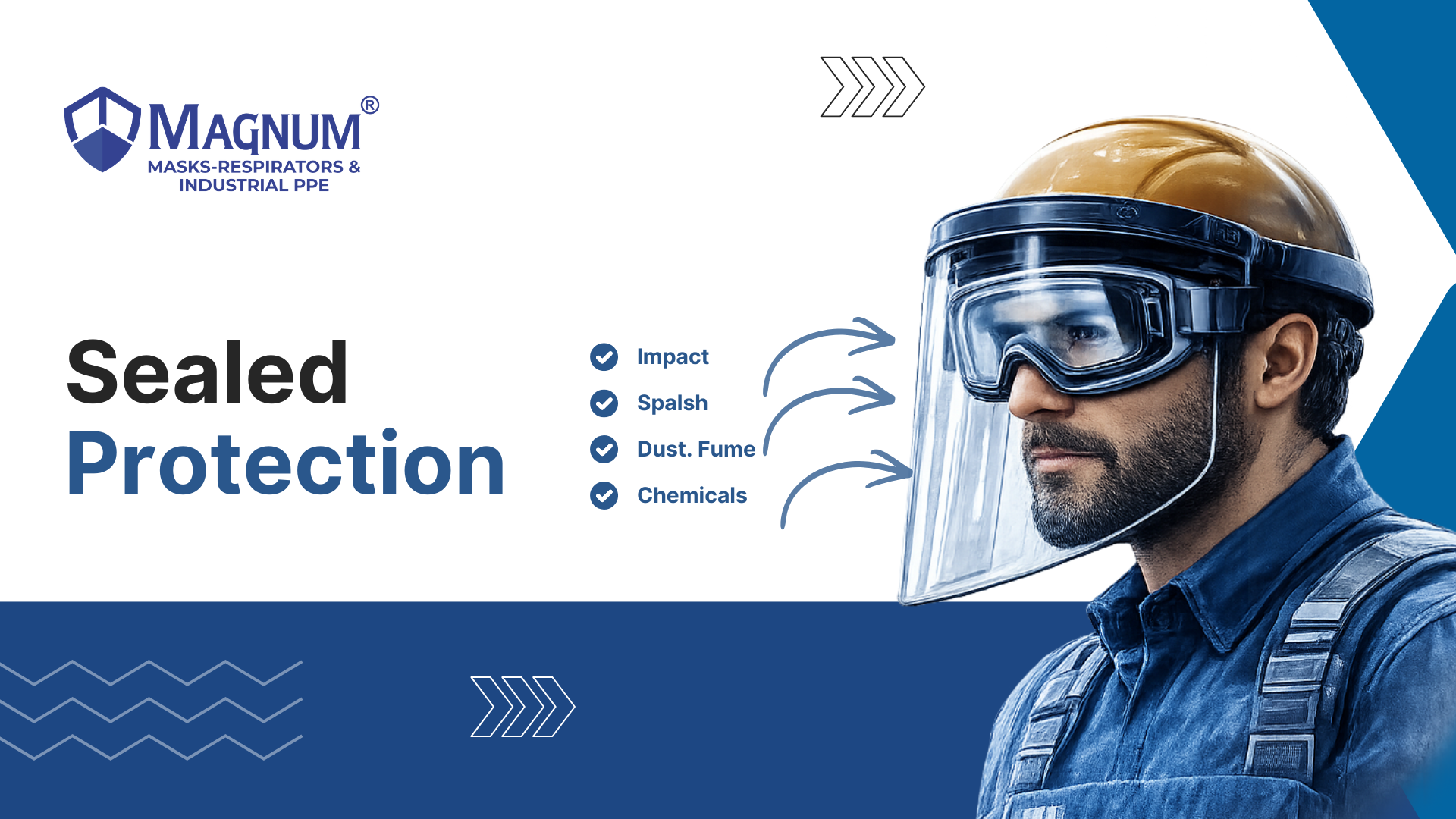
During industrial safety audits, site demonstrations, and training sessions conducted by Magnum Health & Safety Pvt. Ltd., one frequently asked question arises:
“If a face shield already covers the face, why should goggles be worn underneath?”
At first glance, this seems logical. A face shield looks large, solid, and protective. However, in occupational safety engineering, visual coverage is not the same as certified protection. True protection depends on how hazards behave — not how equipment appears.
Understanding this distinction is critical, because many preventable eye injuries occur when workers rely on visible coverage instead of selecting PPE designed for actual exposure pathways.
A face shield is engineered primarily as an impact and splash deflection device. It protects against:
Magnum face shields are designed to deflect these hazards away from facial skin and underlying PPE layers.
However, shields are open-perimeter devices. Air continuously circulates around the sides, top, and bottom. Any contaminant suspended in air — such as dust, fumes, or mist — can travel behind the shield.
So when a worker says:
“Nothing hit my eye, but it started burning later,”
the shield did not fail. The exposure occurred through airflow, which the shield is not designed to seal.
Real Workplace Hazard Behavior
Grinding & Fabrication Operations
Visible sparks are blocked effectively by a shield. But microscopic metal fines rebound from surfaces and stay airborne. As workers move or inhale, these particles drift behind the shield and enter the eye zone.
Liquid splash is deflected by the shield, yet vapour and aerosolized droplets rise with heat currents and reach exposed tissue.
Healthcare & Cleanroom Settings
Droplets may be intercepted, but airborne contaminants remain suspended. Without sealed eye protection, exposure still occurs.
In each scenario, the shield performs exactly as engineered — it stops direct hazards.
The residual risk comes from indirect exposure pathways.
Goggles serve a fundamentally different protective function.
PPE Type Protection Mechanism Hazard Type Controlled
Face Shield Deflection barrier Direct impact / splash
Goggles Sealed enclosure Airborne particles / vapours
Magnum safety goggles are designed with:
International safety standards and industrial risk assessments consistently recommend combined eye-face protection when multiple hazard types are present.
In worker feedback sessions conducted across manufacturing, pharma, and fabrication sectors, the most common reason goggles are skipped is discomfort — usually fogging or heat buildup.
This is precisely why Magnum develops:
Comfort is not a luxury in PPE — it is a compliance factor. Equipment that is comfortable is worn correctly, and equipment worn correctly is protective.
A face shield protects against hazards you can see coming toward you.
Goggles protect against hazards you cannot see moving around you.
They are not substitutes.
They are complementary safety systems engineered for different exposure routes.
Wearing both does not duplicate protection — it completes it.