

 sales@magnumohs.com
 00 91 80808 50482
_Logo.jpg)


Across construction sites, pharmaceutical plants, fabrication workshops, hospitals, and chemical facilities, there is a silent system working every second to protect lives. It is the respirator filtering invisible hazards, the helmet absorbing impact energy, the eyewear shielding vision, and the hearing protector reducing long-term damage.
At Magnum Health & Safety Pvt. Ltd., we have spent more than three decades engineering PPE not as products, but as life-critical systems. Since 1993, our philosophy has remained constant: every piece of protective equipment must perform exactly as intended when the moment demands it.
But there is a truth many workplaces overlook: PPE does not fail suddenly — it weakens quietly over time.
Understanding how and why this happens is essential for anyone responsible for workplace safety.
Even when unused, PPE materials are constantly interacting with their environment. Polymers, elastics, coatings, and filtration media are engineered for durability — but they are not immune to ageing.
Key factors that silently degrade PPE include:
These changes are often invisible until the product is tested under stress — which is precisely when protection matters most.
Safety managers frequently use these terms interchangeably, but they describe completely different timelines.
A respirator stored perfectly for two years does not reset to “new” when opened. The material ageing process never pauses — it only slows under proper storage.
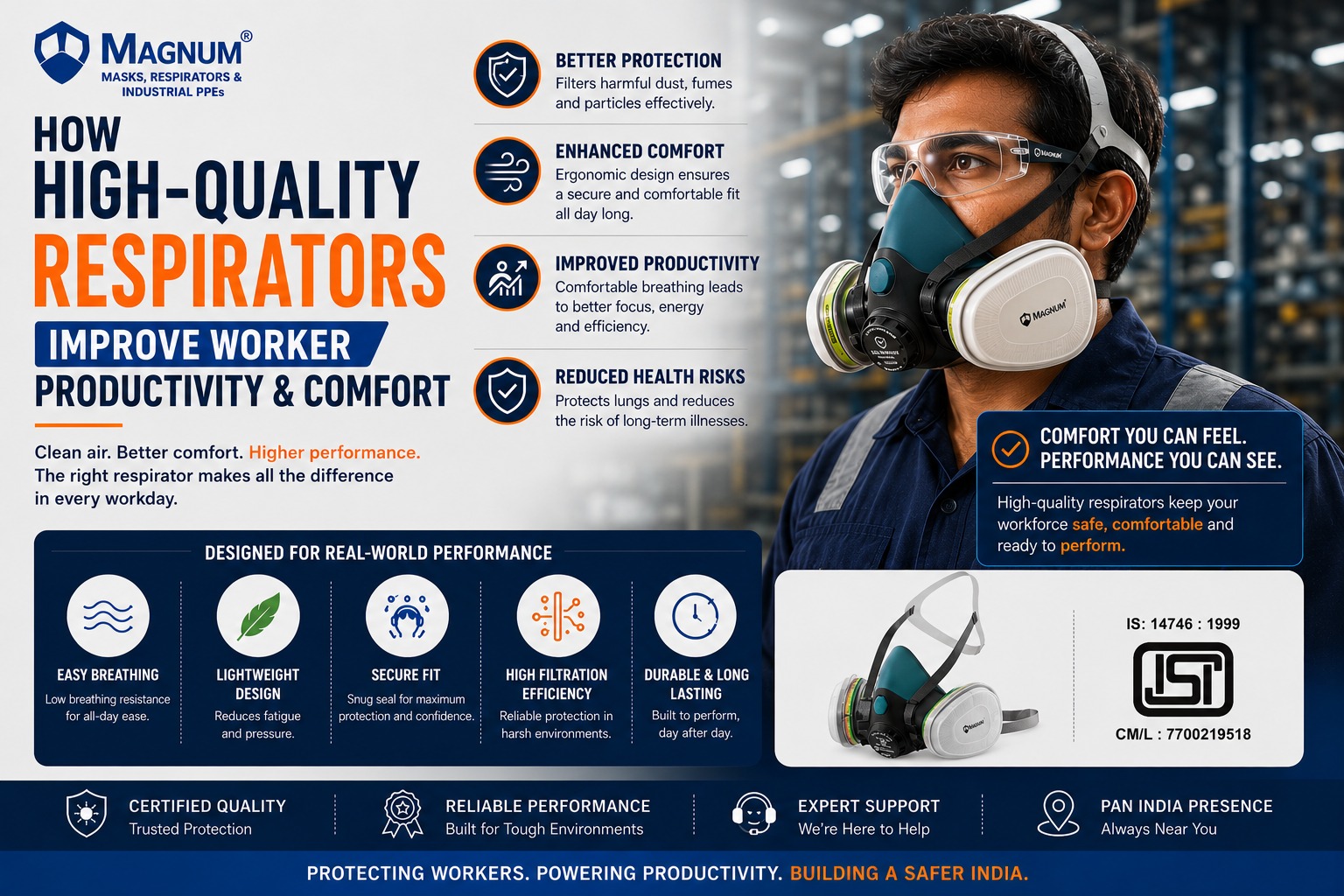
Modern respirators — especially certified particulate respirators and cartridge-based systems — rely on precision-engineered filtration layers and electrostatic charge technology to capture microscopic particles.
However, their efficiency can drop if:
A respirator that looks fine but seals poorly is no longer protective equipment — it becomes a false sense of security.
Industrial safety helmets are engineered to absorb energy through controlled deformation. Magnum helmets, for example, are designed with specific polymer flexibility to dissipate impact force before it reaches the skull.
But polymer ageing changes that behavior. Replace helmets if you observe:
A helmet weakened by UV exposure can fracture instead of flexing — defeating its purpose entirely.
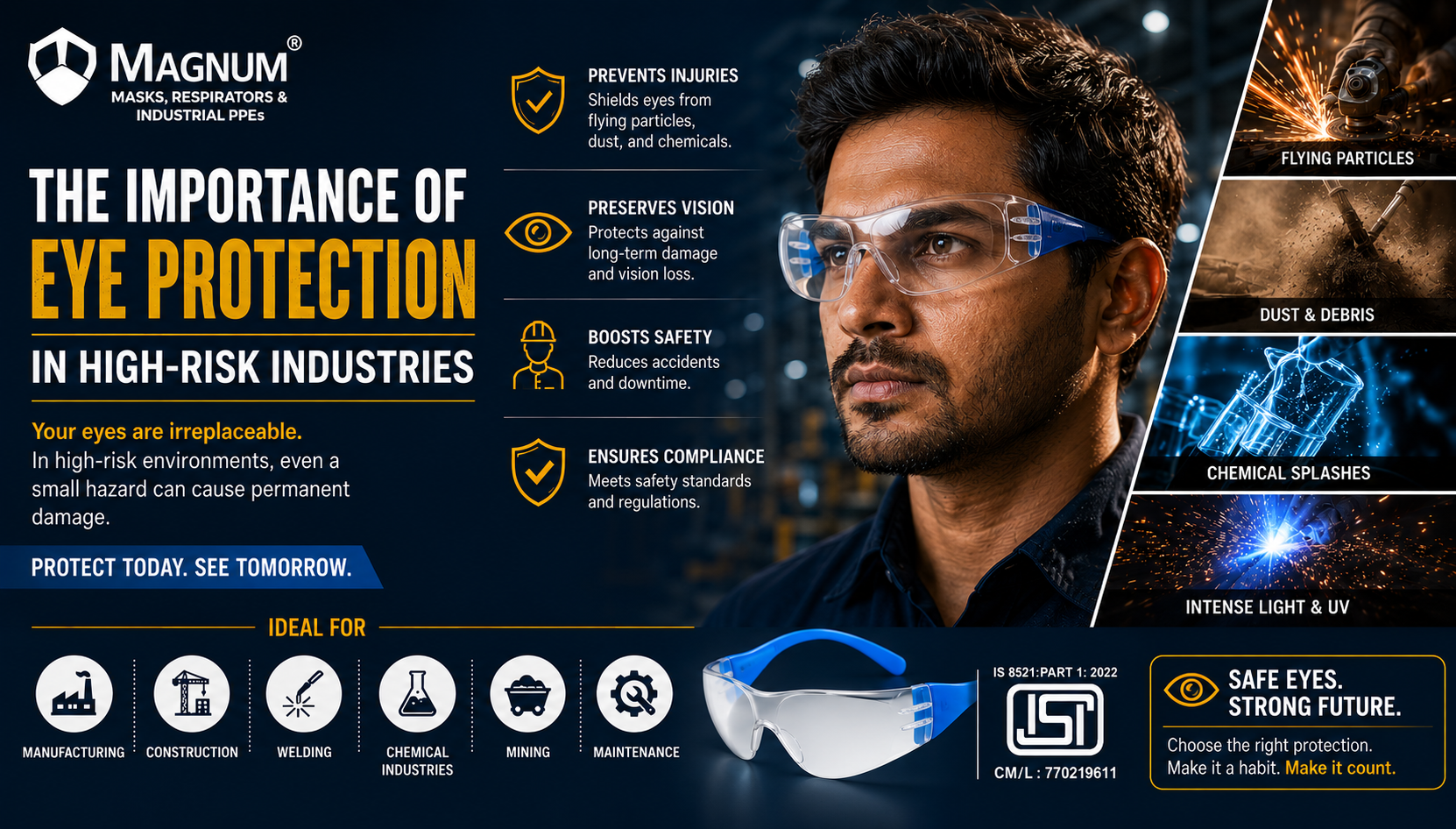
Protection is not only about resistance to impact or splashes. Clear vision directly affects reaction time, precision, and accident prevention.
Replace safety eyewear when:
In environments involving sparks, chemicals, or fine dust, compromised eyewear increases risk exponentially.
Organizations frequently monitor helmets and respirators but forget other essential equipment:
Even the most advanced PPE can degrade prematurely if stored incorrectly. Proper storage is one of the simplest yet most effective safety practices.
Best Storage Practices:
Good storage does not make PPE last forever — but poor storage can shorten its life dramatically.
Waiting until damage is visible is a dangerous strategy. By the time cracks, leaks, or discomfort appear, performance may already be compromised.
A structured replacement schedule ensures:
In safety management, proactive replacement is not an expense — it is risk prevention.
PPE is engineered to protect — but only within its validated lifespan. Heat, light, moisture, chemicals, and time quietly change material behavior long before failure is visible.
What appears serviceable may no longer be protective.
The real question every safety leader should ask regularly: Is our PPE still protecting our people — or are we trusting equipment that has already expired?