

 sales@magnumohs.com
 00 91 80808 50482
_Logo.jpg)

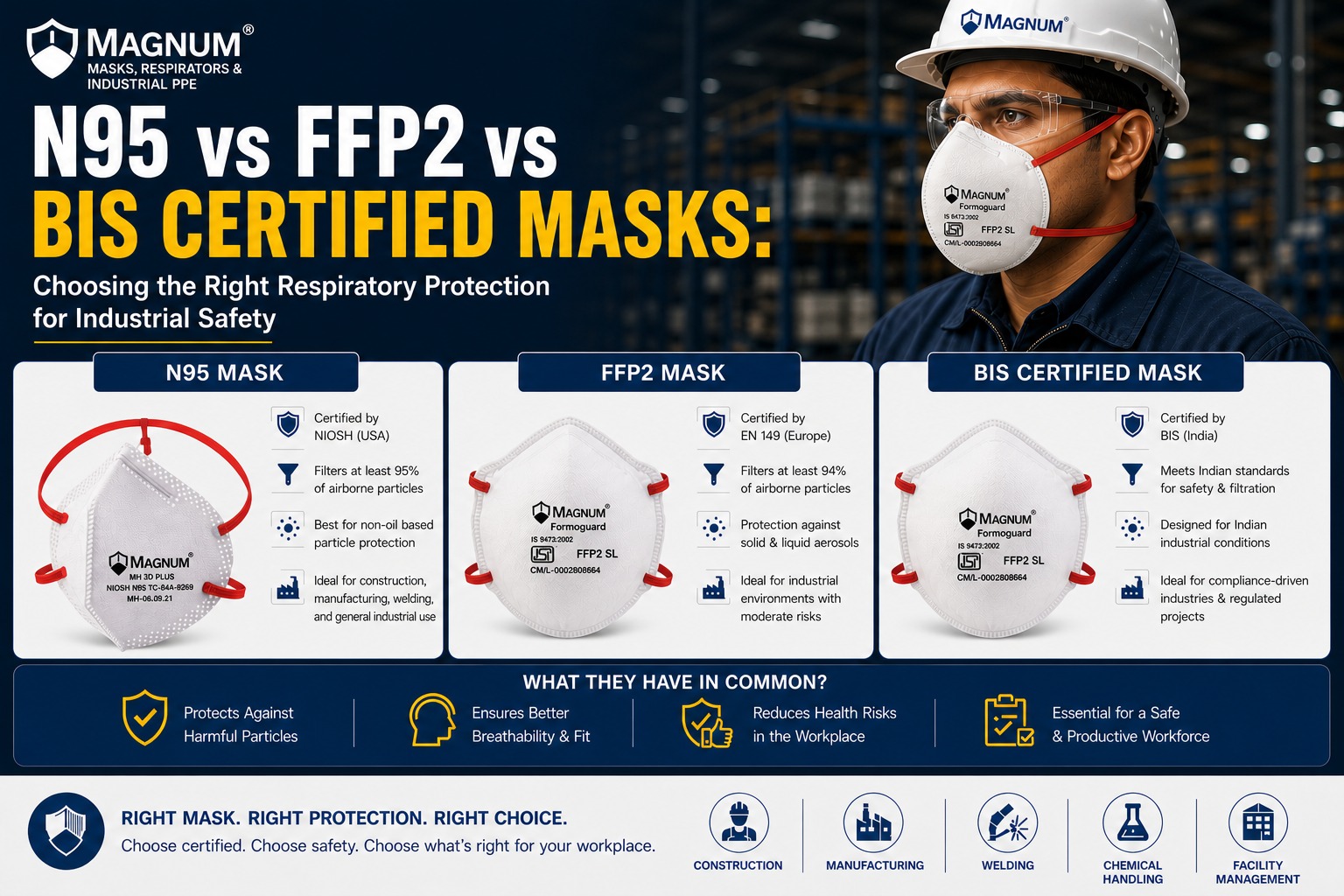
In industrial environments, respiratory protection is not optional. It is critical. Workers are exposed to dust, fumes, fine particles, and airborne contaminants that can cause serious long-term health risks.
With standards such as NIOSH N95, FFP2, and BIS IS 9473 available in the market, many industries face confusion while selecting the right respirator. Each standard has its own approval system, test requirements, filtration level, and regulatory relevance.
For Indian industries, choosing a certified respirator is important not only for worker safety but also for compliance, reliability, and consistent performance.
Magnum Health & Safety Pvt. Ltd. manufactures certified respiratory protection products, including BIS-approved FFP2 filtering half masks under IS 9473 and NIOSH-approved N95 respirators under 42 CFR Part 84.
An N95 respirator is approved by NIOSH (National Institute for Occupational Safety and Health, USA). These respirators are certified under 42 CFR Part 84, which defines approval requirements for respiratory protective devices.
An N95 respirator filters at least 95% of airborne particles and is commonly used in healthcare, pharmaceutical, industrial, and high-risk work environments.
NIOSH-approved respirators carry a TC approval number (e.g., TC-84A-XXXX), which can be verified on the official NIOSH Certified Equipment List.
| Model | NIOSH Approval Number |
|---|---|
| MH 3D PLUS N95 Mask | TC-84A-9269 |
| MH V N95 Mask | TC-84A-6969 |
| MH 3D N95 Mask | TC-84A-9050 |
| MH CUP N95 Mask | TC-84A-9051 |
An FFP2 mask is a filtering facepiece respirator class known for high-efficiency particle filtration.
FFP2 respirators provide approximately 94% filtration efficiency, making them suitable for dust, fumes, and fine airborne particles.
For Indian industries, Magnum offers BIS-approved FFP2 filtering half masks under IS 9473, ensuring compliance with Indian regulatory and workplace requirements.
BIS (Bureau of Indian Standards) certification confirms that the respirator meets Indian standard requirements. The relevant standard for filtering half masks is IS 9473.
Magnum manufactures BIS-approved filtering half masks under IS 9473, including FFP2 class masks. These are suitable for environments involving:
| Category | NIOSH N95 | FFP2 | BIS IS 9473 FFP2 |
|---|---|---|---|
| Approval Body | NIOSH, USA | European category | BIS, India |
| Standard | 42 CFR Part 84 | EN 149 | IS 9473 |
| Filtration Level | Minimum 95% | Approx. 94% | FFP2 under IS 9473 |
| Best Use | Healthcare, pharma, industrial | Industrial dust | Indian compliance |
| Verification | TC number (NIOSH CEL) | Certification docs | BIS licence / ISI mark |
For Indian industrial workplaces, BIS-approved IS 9473 FFP2 masks are a practical and compliant choice.
For companies requiring internationally recognized protection, Magnum’s NIOSH-approved N95 respirators offer verified certification under 42 CFR Part 84.
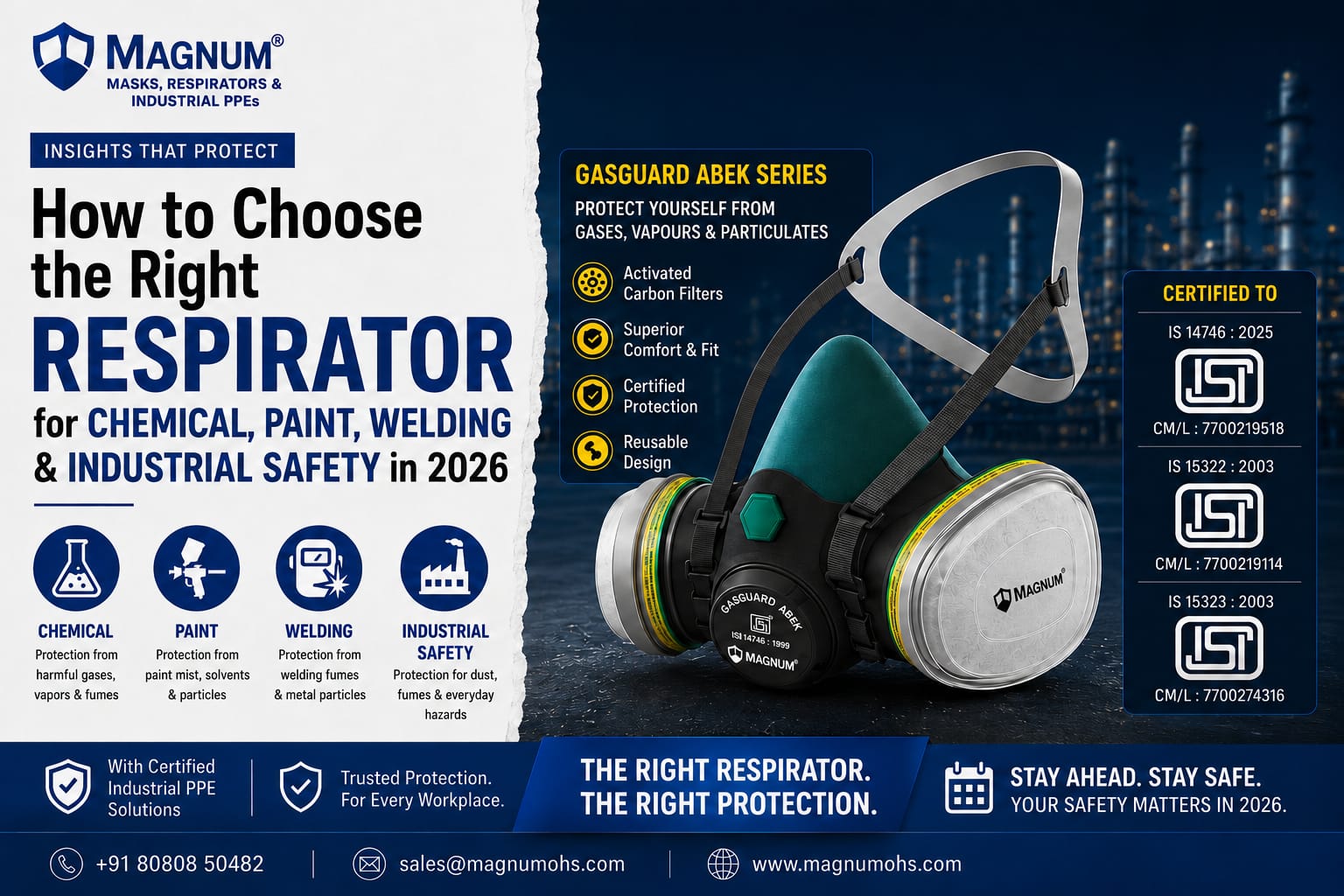
For exposure to gases, vapours, or chemicals, disposable masks like N95 or FFP2 are not sufficient. In such cases, industries should use reusable respirators such as GasGuard half-face or full-face mask systems with appropriate cartridges.
Uncertified masks may seem cheaper, but they can compromise worker safety and create compliance risks.
Certified respirators are tested for:
Magnum focuses on certified PPE solutions, including:
Choosing between N95, FFP2, and BIS-certified masks is not about selecting the most popular option. It is about selecting the right certified respirator based on workplace hazards and compliance requirements.
For Indian industries, BIS-approved IS 9473 FFP2 masks provide practical and compliant protection.
For global requirements, Magnum’s NIOSH-approved N95 respirators under 42 CFR Part 84 offer internationally recognized protection with verifiable approval numbers.
Magnum Health & Safety Pvt. Ltd. continues to support industries with certified, reliable, and performance-tested respiratory protection solutions for safer workplaces.
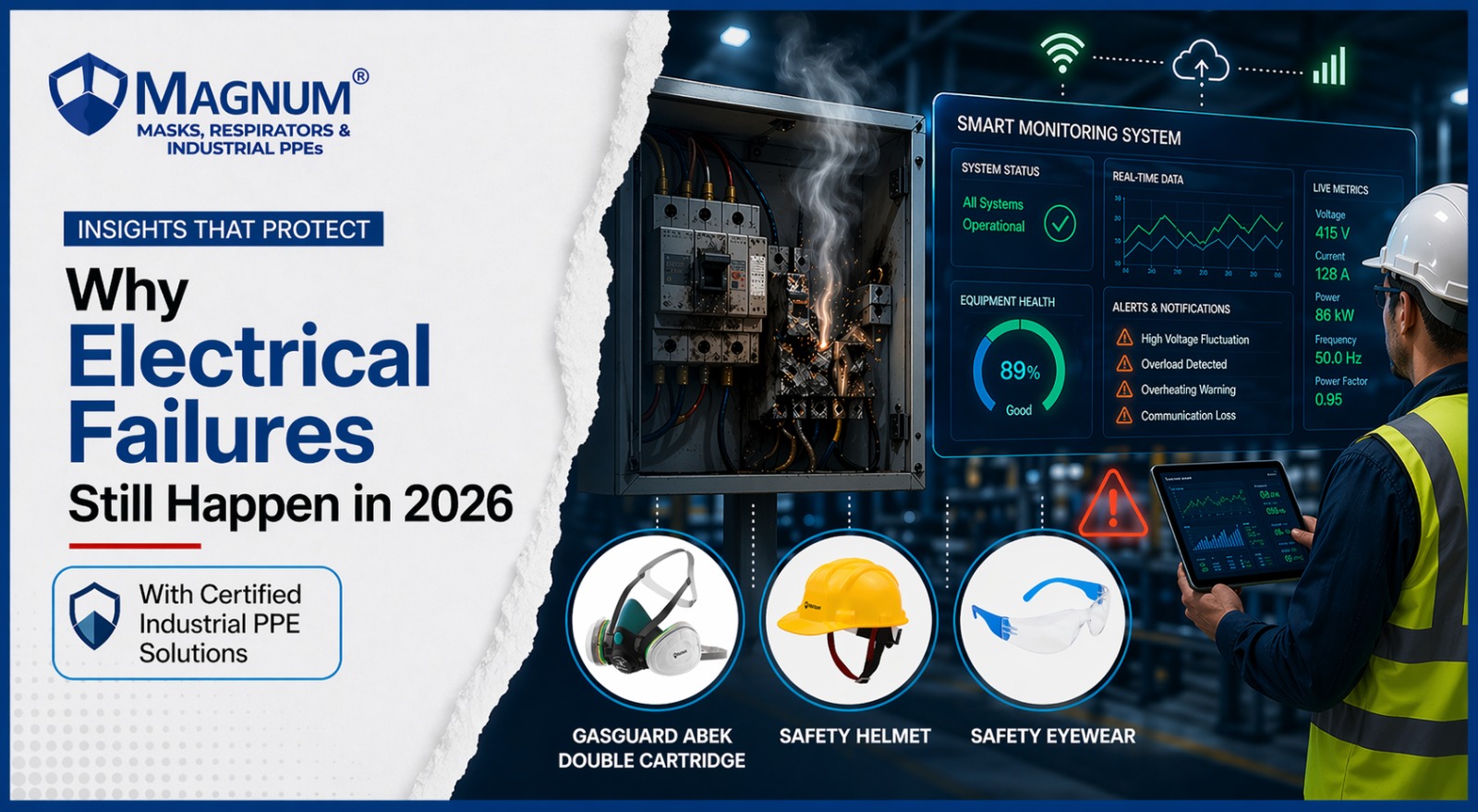
Smart monitoring systems promised a future where electrical faults would be detected before they could cause harm. Sensors now track heat spikes, current anomalies, and insulation degradation in real time.
Yet even in 2026, electrical accidents continue to occur more frequently than expected.
The problem is not the lack of technology. The real issue lies in how that technology is implemented and managed on the ground.
Even the most advanced monitoring systems cannot replace human judgment, disciplined maintenance, and the use of proper personal protective equipment (PPE). When any one of these elements fails, risk increases rapidly.
And when that happens, PPE becomes the final and most critical line of defence.
Despite heavy investments in smart monitoring systems, electrical failures are still driven by a few recurring issues.
Human oversight remains one of the biggest challenges, where alerts are ignored or misinterpreted due to fatigue or lack of attention. Poor maintenance practices, including skipped inspections and loose connections, further increase system vulnerability.
Hidden faults such as internal cable damage or micro-arcing often go undetected by sensors. At the same time, aging infrastructure struggles to handle modern electrical loads.
Additionally, data overload and poor system integration create blind spots, where critical warnings are either delayed or missed entirely.
No monitoring system is effective without human interpretation and timely action.
Even when systems generate alerts, delays in response are common due to alert fatigue, inadequate training, or overly complex dashboards.
This is exactly where certified PPE becomes essential. While monitoring systems can warn about potential danger, PPE is what actually protects workers when things go wrong.
In high-risk situations, PPE is not optional it is a necessity.
At Magnum Health & Safety Pvt. Ltd., PPE is designed for real industrial environments, not just regulatory compliance.
From BIS-approved safety helmets to industrial-grade eyewear and advanced respiratory systems, every product is built to handle real-world hazards.
These solutions are specifically engineered for electrical maintenance teams, plant engineers, and professionals working in high-risk industrial conditions.
Smart monitoring systems can assist in planning maintenance, but they cannot replace it.
Failures such as loose connections, thermal fatigue, and corrosion still occur when maintenance schedules are ignored.
Organizations that combine strict maintenance practices with proper PPE usage consistently experience fewer incidents and improved safety outcomes.
Not all electrical faults are easily detectable in their early stages.
Issues like partial discharge, moisture ingress, and internal micro-arcing often remain unnoticed until significant damage has already occurred.
In such scenarios, workers are exposed to serious risks including toxic fumes, smoke inhalation, and sudden arc events making PPE absolutely critical.
A large portion of industrial infrastructure, especially in developing regions, is operating beyond its intended lifespan.
Outdated wiring systems and aging equipment are not designed to handle modern electrical demands, increasing the likelihood of failures.
While monitoring systems can identify warning signs, they cannot fix structural degradation. PPE acts as a necessary safety buffer for workers operating in these environments.
Modern industrial setups generate massive amounts of data, but more data does not always mean better safety.
Misconfigured thresholds, poor integration between systems, and lack of skilled interpretation often result in critical alerts being overlooked.
To overcome this, organizations must focus on system calibration, integration checks, and proper training while ensuring workers remain fully protected at all times.
Leading organizations follow a structured approach to electrical safety by combining multiple strategies.
They conduct regular PPE audits to ensure compliance, invest in simulation-based training for real-world scenarios, and maintain strict inspection schedules.
Additionally, they perform thermal inspections to detect hidden faults and regularly review their data systems to eliminate blind spots.
With decades of expertise, Magnum provides PPE solutions specifically designed for industrial hazards.
From impact-resistant helmets and anti-fog eyewear to advanced respiratory protection systems, every product is built to deliver reliability and safety.
These solutions are trusted across industries including power, cement, steel, and heavy manufacturing.
Electrical safety cannot rely on monitoring systems alone.
A truly effective safety strategy requires a combination of advanced monitoring, skilled personnel, and certified PPE.
Remove any one of these elements, and the entire system becomes vulnerable.
Safety is not just about detection it is about protection.
Magnum Health & Safety Pvt. Ltd. has been protecting industries for over three decades with reliable and certified safety solutions.
From BIS-certified helmets to NIOSH-approved respirators, every product is built to address real industrial risks.
For expert guidance and safety solutions, visit: www.magnumohs.com
For decades, the healthcare and industrial safety industry has faced a difficult paradox—protect lives today while unintentionally impacting the environment tomorrow. Every mask, every helmet, every disposable product contributes to a growing footprint of waste.
At Magnum Health & Safety, with over three decades of expertise in manufacturing certified Personal Protective Equipment (PPE), we believe leadership today is not just about performance—it’s about responsibility, compliance, and future readiness.
Our mission is clear: 👉 Deliver globally certified protection 👉 Integrate sustainable manufacturing practices 👉 Ensure zero compromise on safety standards
The backbone of PPE performance lies in materials—especially in products like filtering half masks, surgical masks, and respirators.
At Magnum, we are actively working toward:
Our goal is simple: ✔ Protect workers and patients ✔ Reduce long-term environmental burden
Sustainability is not just about materials—it’s about how products are manufactured.
Across Magnum’s facilities:
Whether it’s N95 respirators, safety eyewear, or folding helmets, every product is manufactured with a focus on efficiency + consistency + compliance.
Traditional PPE packaging often leads to unnecessary plastic waste. Magnum is actively redesigning this system:
Result: 📦 Less waste 🚢 Lower logistics cost 🌍 Reduced environmental impact
In PPE, sustainability can never come at the cost of safety.
Magnum products are backed by globally recognized certifications and approvals:
Every innovation we introduce is validated against strict regulatory frameworks, ensuring: ✔ Consistent performance ✔ Trusted protection ✔ Global acceptance
Magnum offers an integrated range of certified PPE solutions:
This allows distributors, hospitals, and industries to source end-to-end certified protection from a single trusted manufacturer.
Magnum Health And Safety Pvt. Ltd.
Address:- Plot No.19, Near Vasai Frozen Food Company,
Kaman Bhiwandi Road, Village – Poman, Taluka – Vasai,
Dist – Palghar – 401 208.
Email:- info@magnumohs.com
Phone:- +91 8080850482
Major Workplace Hazards Prevented by Respiratory Protection, Eye Protection, Head Protection and Hygiene PPE
Workplace safety has become a critical priority across industries such as construction, manufacturing, healthcare, pharmaceuticals, laboratories, and logistics. Workers are often exposed to airborne particles, falling objects, flying debris, biological contaminants, and hazardous dust that can lead to injuries or long-term health complications.
While engineering controls and safety procedures help reduce risks, Personal Protective Equipment (PPE) remains the final and most reliable barrier between workers and workplace hazards.
For more than three decades, Magnum Health & Safety Pvt. Ltd. has been manufacturing certified PPE solutions, including filtering half masks, surgical masks, safety eyewear, industrial safety helmets, surgical caps, bouffant caps, and protective shoe covers.
Magnum PPE products are designed and tested to meet international and Indian safety standards such as NIOSH approvals, BIS certifications (including IS 16289 for surgical masks), and US FDA approvals, ensuring reliable protection across both industrial and healthcare environments.
Below are some of the most common workplace hazards and how proper PPE helps prevent them.
Airborne contaminants are among the most dangerous hazards in industrial environments. Dust from cement, silica, coal, wood, welding fumes, and industrial smoke can penetrate deep into the lungs and cause respiratory diseases.
Industries particularly exposed to airborne hazards include:
Magnum manufactures advanced filtering half masks and N95 respirators designed to filter harmful airborne particles.
Key protection features include:
These respirators protect workers from harmful dust and airborne contaminants in demanding environments.
Hospitals, laboratories, pharmaceutical plants, and diagnostic centers face exposure to airborne microorganisms, bacteria, and viruses.
Healthcare workers must maintain strict hygiene and respiratory protection standards to prevent cross contamination.
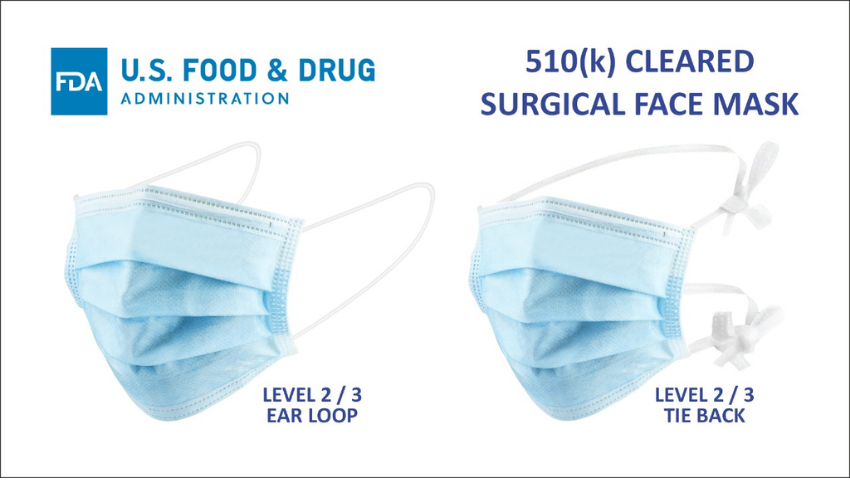
Magnum manufactures high-quality surgical face masks compliant with BIS Standard IS 16289 and approved by the US FDA.
Magnum surgical masks provide:
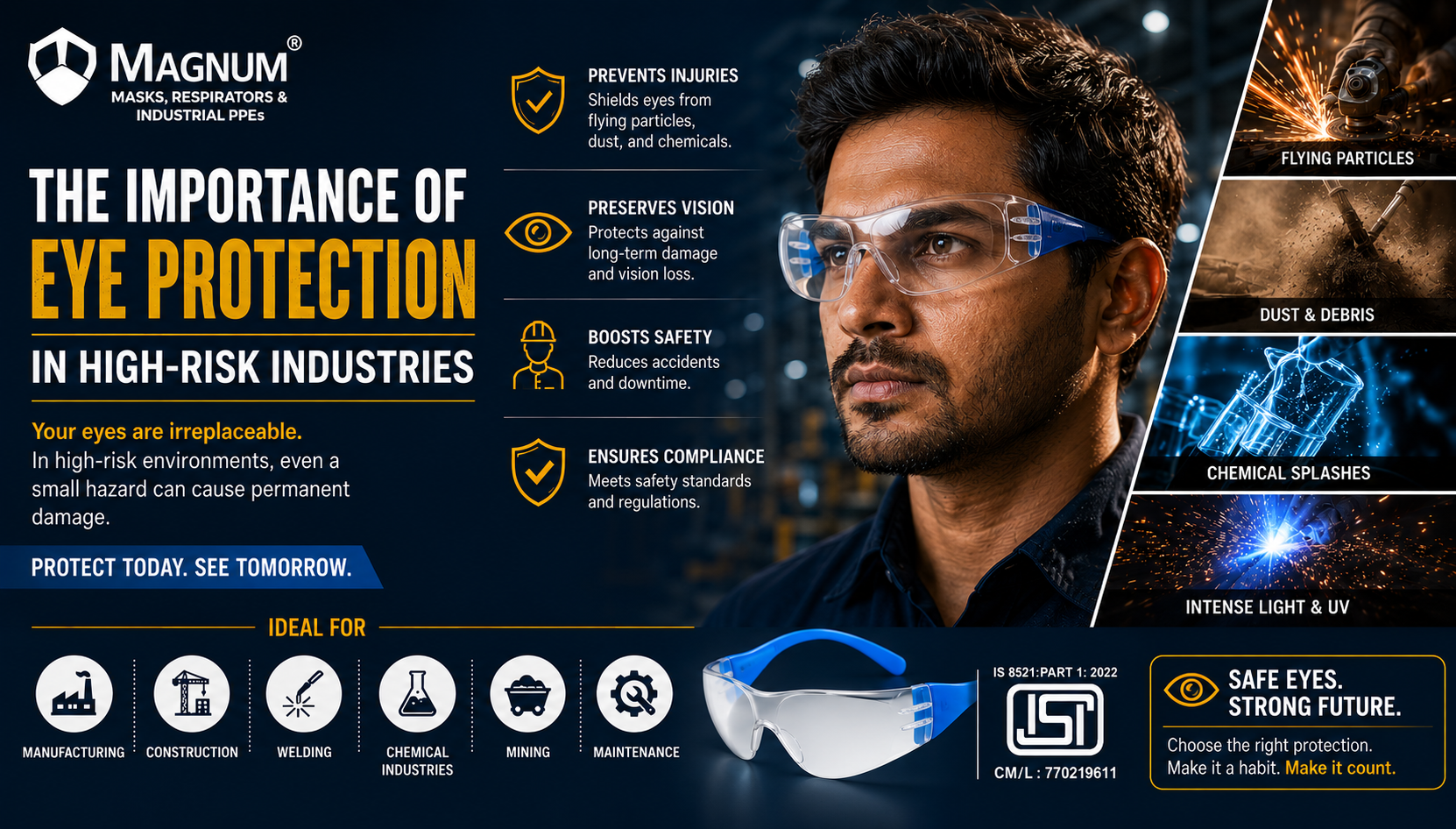
Industrial activities such as grinding, drilling, cutting, and welding often generate high-velocity particles that can cause severe eye injuries.
Even a small metal fragment or dust particle can damage eyesight permanently.
Magnum safety eyewear and goggles are designed to protect workers from impact hazards.
Key protection features include:
In construction sites, warehouses, and manufacturing plants, workers are frequently exposed to falling tools, building materials, and moving equipment.
Head injuries can be life-threatening without proper protection.
Magnum manufactures industrial safety helmets engineered for high impact protection and durability.
These helmets offer:
Magnum also offers innovative patented folding helmets, designed for portability while maintaining full safety performance.
Workers operating in confined industrial spaces or near heavy machinery are at risk of accidental head impacts.
Without proper head protection, even minor collisions can result in serious injury.
Magnum helmets distribute impact forces across the shell structure, reducing injury risks and improving worker safety in high-risk industrial areas.
Construction sites generate large quantities of fine dust particles during drilling, cutting, demolition, and cement mixing operations.
Long-term exposure to these particles can cause chronic respiratory conditions.
Magnum dust masks and filtering half masks help protect workers from inhaling harmful particles generated during construction activities.
These masks are widely used in:
Laboratories, pharmaceutical manufacturing units, and chemical industries involve handling liquids and substances that can cause irritation or injury.
Magnum safety goggles protect workers from:
Combined with respiratory protection, this PPE ensures safety during chemical handling operations.
In hospitals, food processing plants, and pharmaceutical facilities, contamination control is essential.
Hair, footwear contamination, and airborne particles can compromise sterile environments.
Magnum manufactures a range of disposable hygiene PPE including:
These products help maintain cleanroom hygiene and infection control in sensitive environments.
Strict hygiene standards must be maintained in pharmaceutical production and food manufacturing facilities to prevent contamination.
Magnum disposable caps and shoe covers help ensure:
Not all PPE offers the same level of protection. Certification, testing, and manufacturing quality play a crucial role in ensuring reliable safety.
Magnum PPE products stand out because of:
Workplace hazards cannot always be eliminated, but their impact can be significantly reduced with the right protective equipment.
From filtering half masks that protect the lungs, to safety eyewear that shields the eyes, helmets that protect the head, and medical hygiene PPE that prevents contamination, PPE plays a critical role in safeguarding workers across industries.
By investing in certified and high-quality PPE solutions from trusted manufacturers like Magnum, organizations can build safer workplaces while protecting their most valuable asset — their people.
Magnum Health And Safety Pvt. Ltd.
Address:- Plot No.19, Near Vasai Frozen Food Company,
Kaman Bhiwandi Road, Village – Poman, Taluka – Vasai,
Dist – Palghar – 401 208.
Email:- info@magnumohs.com
Phone:- +91 8080850482
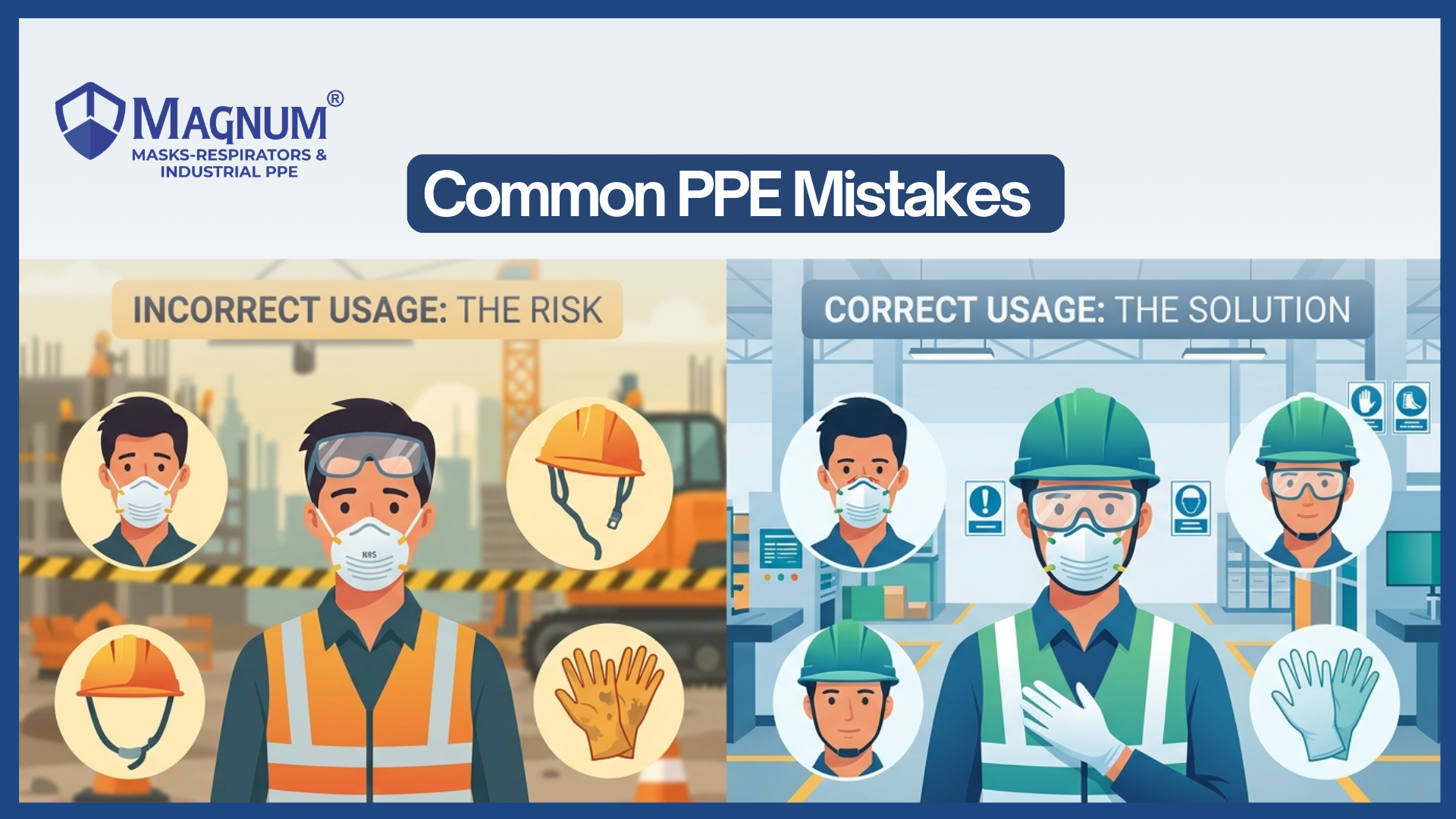
Buying Personal Protective Equipment (PPE) is only half the battle. A warehouse can be fully stocked with masks, helmets, eyewear, and gloves, but if PPE is not used correctly on the shop floor, construction site, laboratory, or hospital, the protection it promises simply disappears.
For safety officers, procurement heads, and facility managers, the real objective is not just supplying PPE—it is creating a workplace where safety practices become second nature.
At Magnum Health & Safety, we have spent more than three decades designing and manufacturing certified PPE used across industries such as construction, pharmaceuticals, oil & gas, infrastructure, healthcare, and heavy manufacturing. Through years of interaction with safety professionals, we’ve noticed a few common mistakes workers often make while using PPE—and more importantly, how organizations can prevent them.
One of the most common scenes on a worksite is a mask worn below the nose or safety eyewear pushed onto the forehead. Workers don’t intentionally break safety rules—they usually do it because the PPE feels uncomfortable.
The Mistake When PPE is poorly designed or poorly fitted, workers tend to “adjust” it for comfort. Unfortunately, this adjustment often breaks the protective seal or removes the barrier entirely.
For example:
The Magnum Approach Magnum focuses heavily on ergonomic engineering when designing PPE. Our respirators and filtering half masks are designed with:
This ensures workers can wear protection through long shifts without discomfort, increasing compliance on the floor. Our products are tested and certified under standards such as:
When PPE feels right, workers are far more likely to wear it correctly.
Many workplaces make the mistake of assuming a single type of mask or protective gear is suitable for every application.
The Mistake Using basic PPE for high-risk environments. Examples include:
Each hazard requires a specific level of protection.
The Magnum Solution Magnum offers a complete range of industrial PPE, each designed for a specific hazard category. Our product portfolio includes:
By selecting the right PPE for the right hazard, companies drastically reduce workplace risk.
In busy workplaces, it’s tempting to reuse disposable PPE “just one more time.” While this may seem economical in the short term, it often increases the risk of contamination or failure.
The Mistake Reusing disposable PPE compromises:
For example:
The Magnum Advantage Magnum’s manufacturing facilities are designed for consistent large-scale supply, ensuring companies never face shortages. Key strengths include:
Our products are manufactured under ISO-certified quality systems and exported to multiple countries, ensuring dependable availability. When workers always have access to fresh PPE, the temptation to reuse disappears.
One of the most overlooked risks is how PPE is put on and removed. These two moments—known as Donning and Doffing—are where many exposures occur.
The Mistake Workers may accidentally touch contaminated surfaces of gloves, respirators, gowns, or goggles while removing them. This transfers contamination directly to the skin or nearby surfaces.
The Right Approach Creating a strong safety culture is essential. Organizations should encourage:
Magnum also supports organizations through technical guidance and PPE education, helping safety officers implement correct usage practices.
Workplace safety is not achieved simply by enforcing rules—it is achieved when safe behavior becomes the easiest behavior. When workers are given PPE that is comfortable, certified, reliable, and easy to use, they are far less likely to take shortcuts.
With over 30 years of manufacturing expertise, Magnum Health & Safety continues to design PPE that meets the highest safety standards across global markets. Our commitment to innovation, certified protection, and reliable supply helps industries build workplaces where every worker goes home safe.
Magnum Health And Safety Pvt. Ltd.
Address:- Plot No.19, Near Vasai Frozen Food Company,
Kaman Bhiwandi Road, Village – Poman, Taluka – Vasai,
Dist – Palghar – 401 208.
Email:- info@magnumohs.com
Phone:- +91 8080850482