

 sales@magnumohs.com
 00 91 80808 50482
_Logo.jpg)

Hospital procurement teams face a constant challenge:
Maintain the highest infection control standards — while keeping costs under control.
But here’s a question worth asking:
Many hospitals still buy medical disposables through multiple distributors and traders, and every step in that chain quietly adds cost.
A simple box of surgical masks may pass through:
By the time it reaches your hospital, the price may be 25–50% higher than factory cost.
That’s the “Middleman Tax.”
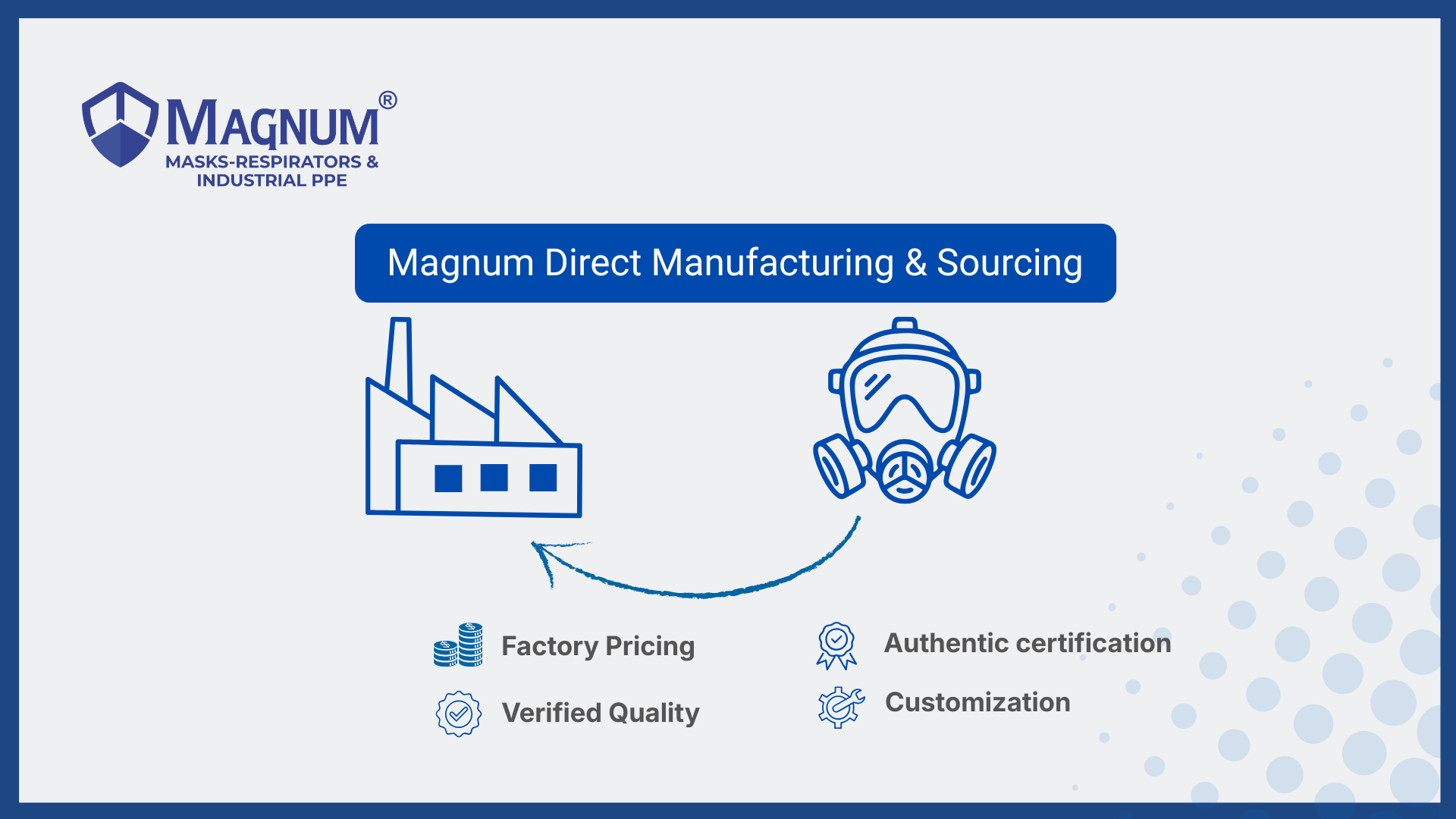
Forward-thinking healthcare institutions are now building direct partnerships with certified manufacturers.
The benefits go far beyond price.
1️⃣ Cost Efficiency
Direct sourcing eliminates unnecessary layers in the supply chain, giving hospitals factory-level pricing.
2️⃣ Verified Quality
Instead of relying on trader claims, hospitals receive authentic certification and test reports directly from the manufacturer.
At Magnum Health & Safety Pvt. Ltd., products are manufactured under globally recognized approvals such as:
3️⃣ Supply Chain Security
Traders depend on whoever has stock. Manufacturers control production capacity.
Direct relationships ensure priority supply during demand surges, which is critical for hospitals.
4️⃣ Customization
Direct manufacturing partnerships allow hospitals to request:
This reduces waste and improves operational efficiency.
In healthcare procurement, the cheapest product is not always the most economical one.
A surgical mask that fails during a procedure can cost far more than its purchase price.
The real goal is Total Cost of Ownership (TCO) — balancing cost, reliability, certification, and supply security.
For over three decades, Magnum Health & Safety Pvt. Ltd., India has been manufacturing protective equipment and medical disposables for global markets.
Our product range includes:
Today, Magnum exports PPE and medical disposables to 20+ countries worldwide.
When was the last time you reviewed how your medical disposables are sourced?
A supply chain audit may reveal significant opportunities for:
✔ Cost savings ✔ Quality transparency ✔ Reliable supply
If your hospital or distribution network is exploring direct sourcing from certified manufacturers, our team would be happy to connect.
📩 Contact Magnum’s Export Division to request product samples or bulk quotations.

In a busy Indian operating theatre or on a manufacturing shop floor running at 40°C with high humidity, a mask is supposed to protect the wearer. But in reality, many masks become something else entirely:
A breathing barrier that staff secretly hate.
Procurement managers and safety officers see the symptoms every day:
The instinctive reaction is often to blame user compliance.
But after decades in PPE manufacturing, we can say with confidence:
The problem usually isn’t the wearer — it’s the mask technology.
And more specifically, it’s the meltblown layer inside the mask.
Every surgical mask or filtering respirator has an invisible engine — the meltblown filtration layer.
This layer determines two critical factors:
In many low-cost masks, manufacturers achieve filtration simply by making the meltblown thicker and denser. On paper this works. In practice, especially in Indian summer conditions, it creates serious problems.
Dense mechanical filtration often results in:
For a nurse in an ICU or a worker wearing PPE for 6–8 hours, this becomes a real operational issue.
The new generation of masks uses electrostatically charged meltblown media.
Instead of relying purely on dense fabric to block particles, electrostatic filtration works like a microscopic magnet, attracting airborne particles without restricting airflow.
This technology allows masks to achieve:
At Magnum Health & Safety, our surgical masks and filtering respirators use high-performance meltblown filtration media designed for long-duration wear in demanding climates.
In India, certification is no longer optional. Large hospital networks, government buyers and GeM procurement increasingly require verified testing and certification.
Key benchmarks include:
BIS IS 16289 (Surgical Masks) BIS certification ensures masks meet requirements for:
SITRA Testing The South India Textile Research Association (SITRA) is one of India’s most respected mask testing laboratories. SITRA reports verify actual performance parameters such as:
NIOSH Certification for Respirators For higher risk environments, NIOSH approved N95 respirators provide certified protection against airborne particles. Magnum manufactures NIOSH approved N95 respirators designed for:
Global PPE designs often assume temperate climates. But India presents unique challenges:
In such conditions, masks that rely on dense mechanical filtration quickly become uncomfortable. Magnum’s filtration media is engineered with moisture-resistant properties that help maintain filtration integrity even during long shifts in humid environments.
This helps ensure:
Because in real-world PPE use, comfort drives compliance.
When procurement teams evaluate large tenders — sometimes 10 lakh masks or more — the difference of 20–30 paise per mask can look significant. But the true cost of low-breathability masks appears elsewhere.
Magnum Health & Safety designs PPE not as isolated products but as integrated protection systems for healthcare and industrial environments.
Our range includes:
With over three decades of manufacturing expertise, Magnum supplies PPE solutions to hospitals, pharmaceutical facilities, and industrial sectors in India and global markets.
Before finalizing your next procurement order, ask your supplier:
1️⃣ Is the meltblown filtration media electrostatically charged?
2️⃣ Can you provide BIS or SITRA reports showing breathability (Delta P)?
3️⃣ Are the mask components — such as nose clips and elastic bands — designed for long shifts and humid environments?
If the answers are unclear, it may be time to review your supplier.
India’s healthcare and industrial sectors are evolving rapidly. Today’s PPE procurement must balance:
At Magnum Health & Safety Pvt. Ltd., we believe the most important part of a mask is the part you cannot see — the science behind the filtration.
Because effective PPE should support your team through the entire shift — not become the reason they take it off.

Across construction sites, pharmaceutical plants, fabrication workshops, hospitals, and chemical facilities, there is a silent system working every second to protect lives. It is the respirator filtering invisible hazards, the helmet absorbing impact energy, the eyewear shielding vision, and the hearing protector reducing long-term damage.
At Magnum Health & Safety Pvt. Ltd., we have spent more than three decades engineering PPE not as products, but as life-critical systems. Since 1993, our philosophy has remained constant: every piece of protective equipment must perform exactly as intended when the moment demands it.
But there is a truth many workplaces overlook: PPE does not fail suddenly — it weakens quietly over time.
Understanding how and why this happens is essential for anyone responsible for workplace safety.
Even when unused, PPE materials are constantly interacting with their environment. Polymers, elastics, coatings, and filtration media are engineered for durability — but they are not immune to ageing.
Key factors that silently degrade PPE include:
These changes are often invisible until the product is tested under stress — which is precisely when protection matters most.
Safety managers frequently use these terms interchangeably, but they describe completely different timelines.
A respirator stored perfectly for two years does not reset to “new” when opened. The material ageing process never pauses — it only slows under proper storage.
Modern respirators — especially certified particulate respirators and cartridge-based systems — rely on precision-engineered filtration layers and electrostatic charge technology to capture microscopic particles.
However, their efficiency can drop if:
A respirator that looks fine but seals poorly is no longer protective equipment — it becomes a false sense of security.
Industrial safety helmets are engineered to absorb energy through controlled deformation. Magnum helmets, for example, are designed with specific polymer flexibility to dissipate impact force before it reaches the skull.
But polymer ageing changes that behavior. Replace helmets if you observe:
A helmet weakened by UV exposure can fracture instead of flexing — defeating its purpose entirely.
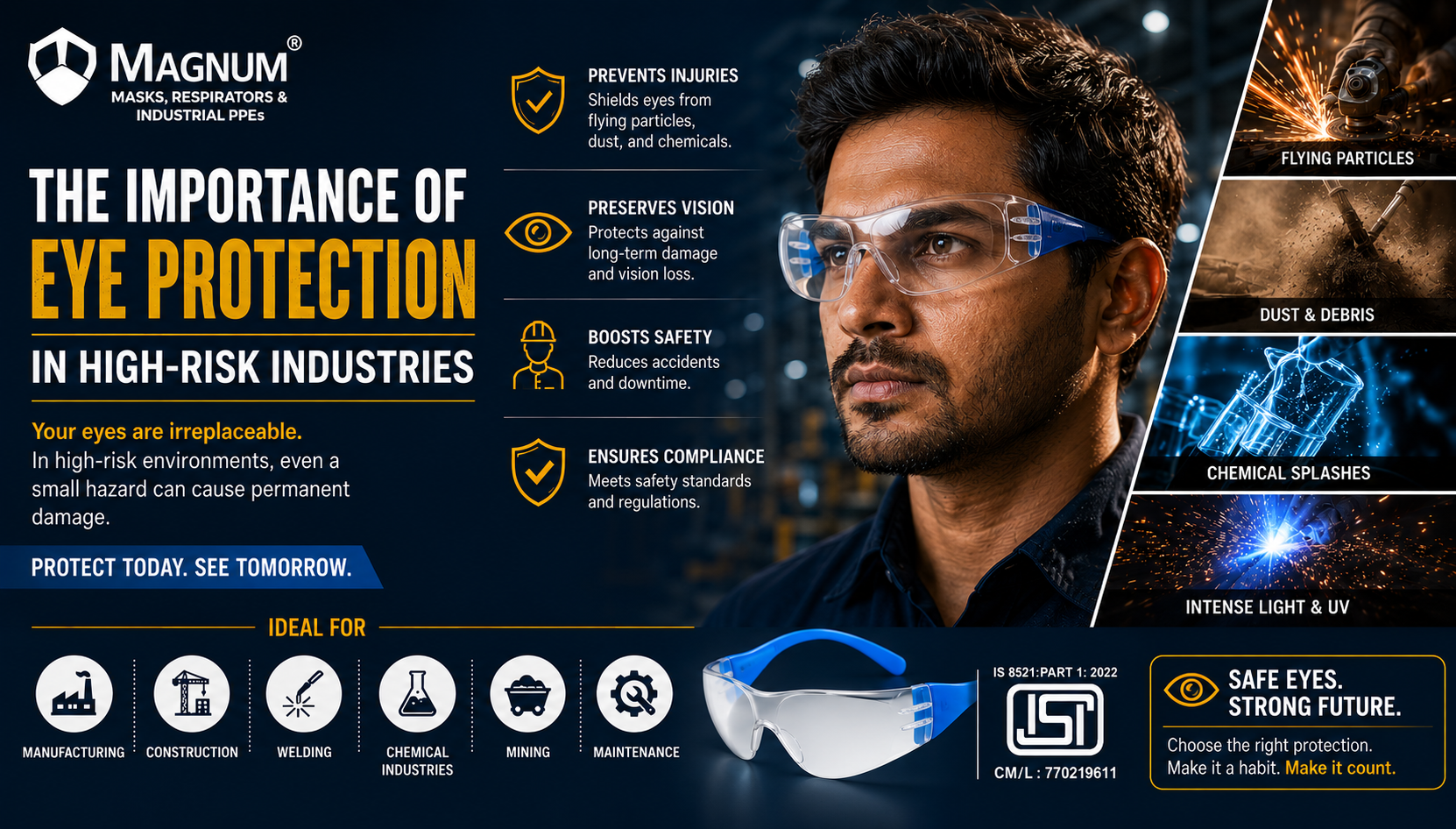
Protection is not only about resistance to impact or splashes. Clear vision directly affects reaction time, precision, and accident prevention.
Replace safety eyewear when:
In environments involving sparks, chemicals, or fine dust, compromised eyewear increases risk exponentially.
Organizations frequently monitor helmets and respirators but forget other essential equipment:
Even the most advanced PPE can degrade prematurely if stored incorrectly. Proper storage is one of the simplest yet most effective safety practices.
Best Storage Practices:
Good storage does not make PPE last forever — but poor storage can shorten its life dramatically.
Waiting until damage is visible is a dangerous strategy. By the time cracks, leaks, or discomfort appear, performance may already be compromised.
A structured replacement schedule ensures:
In safety management, proactive replacement is not an expense — it is risk prevention.
PPE is engineered to protect — but only within its validated lifespan. Heat, light, moisture, chemicals, and time quietly change material behavior long before failure is visible.
What appears serviceable may no longer be protective.
The real question every safety leader should ask regularly: Is our PPE still protecting our people — or are we trusting equipment that has already expired?
During industrial safety audits, site demonstrations, and training sessions conducted by Magnum Health & Safety Pvt. Ltd., one frequently asked question arises:
“If a face shield already covers the face, why should goggles be worn underneath?”
At first glance, this seems logical. A face shield looks large, solid, and protective. However, in occupational safety engineering, visual coverage is not the same as certified protection. True protection depends on how hazards behave — not how equipment appears.
Understanding this distinction is critical, because many preventable eye injuries occur when workers rely on visible coverage instead of selecting PPE designed for actual exposure pathways.
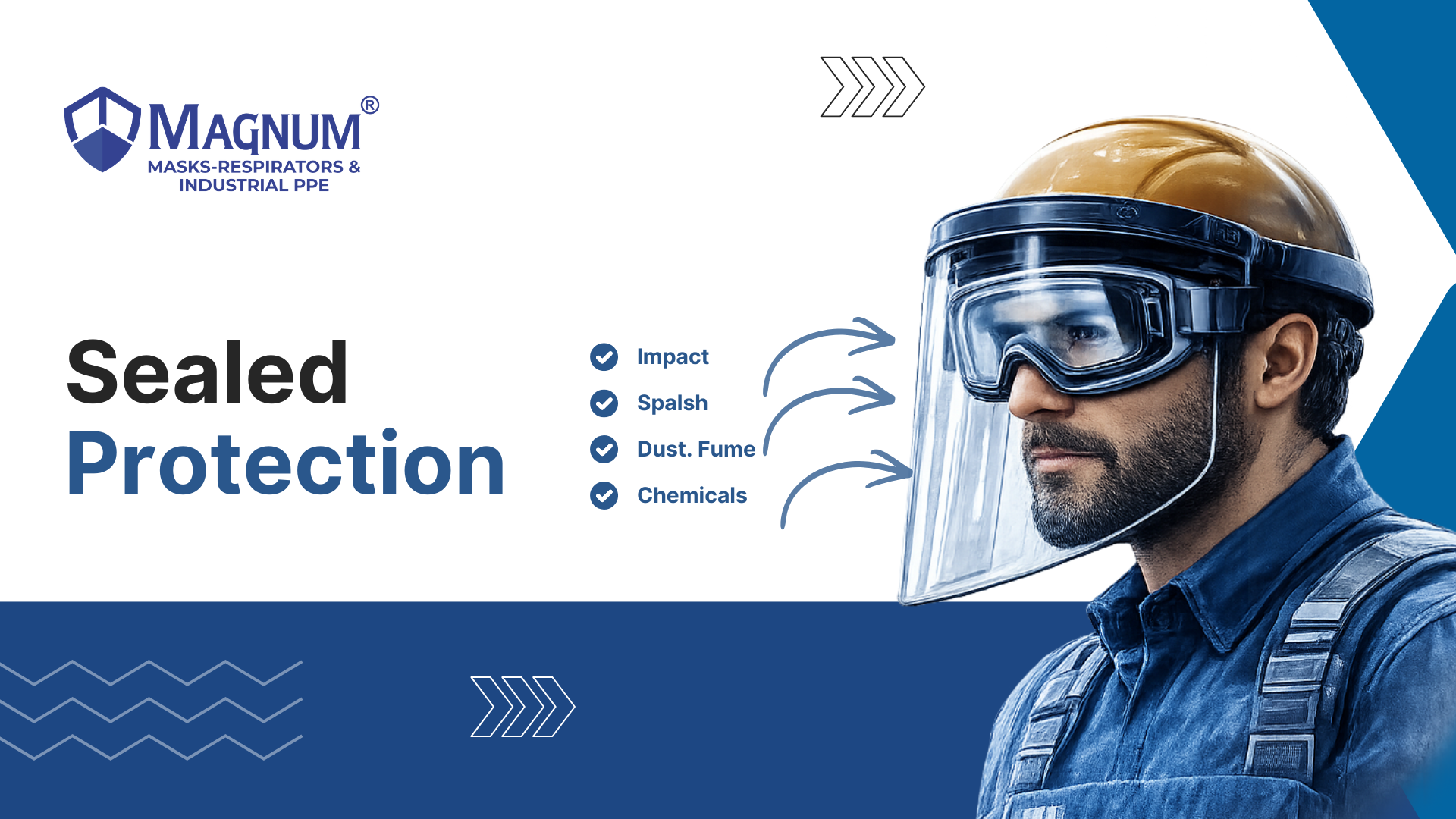
A face shield is engineered primarily as an impact and splash deflection device. It protects against:
Magnum face shields are designed to deflect these hazards away from facial skin and underlying PPE layers.
However, shields are open-perimeter devices. Air continuously circulates around the sides, top, and bottom. Any contaminant suspended in air — such as dust, fumes, or mist — can travel behind the shield.
So when a worker says:
“Nothing hit my eye, but it started burning later,”
the shield did not fail. The exposure occurred through airflow, which the shield is not designed to seal.
Real Workplace Hazard Behavior
Grinding & Fabrication Operations
Visible sparks are blocked effectively by a shield. But microscopic metal fines rebound from surfaces and stay airborne. As workers move or inhale, these particles drift behind the shield and enter the eye zone.
Liquid splash is deflected by the shield, yet vapour and aerosolized droplets rise with heat currents and reach exposed tissue.
Healthcare & Cleanroom Settings
Droplets may be intercepted, but airborne contaminants remain suspended. Without sealed eye protection, exposure still occurs.
In each scenario, the shield performs exactly as engineered — it stops direct hazards.
The residual risk comes from indirect exposure pathways.
Goggles serve a fundamentally different protective function.
PPE Type Protection Mechanism Hazard Type Controlled
Face Shield Deflection barrier Direct impact / splash
Goggles Sealed enclosure Airborne particles / vapours
Magnum safety goggles are designed with:
International safety standards and industrial risk assessments consistently recommend combined eye-face protection when multiple hazard types are present.
In worker feedback sessions conducted across manufacturing, pharma, and fabrication sectors, the most common reason goggles are skipped is discomfort — usually fogging or heat buildup.
This is precisely why Magnum develops:
Comfort is not a luxury in PPE — it is a compliance factor. Equipment that is comfortable is worn correctly, and equipment worn correctly is protective.
A face shield protects against hazards you can see coming toward you.
Goggles protect against hazards you cannot see moving around you.
They are not substitutes.
They are complementary safety systems engineered for different exposure routes.
Wearing both does not duplicate protection — it completes it.
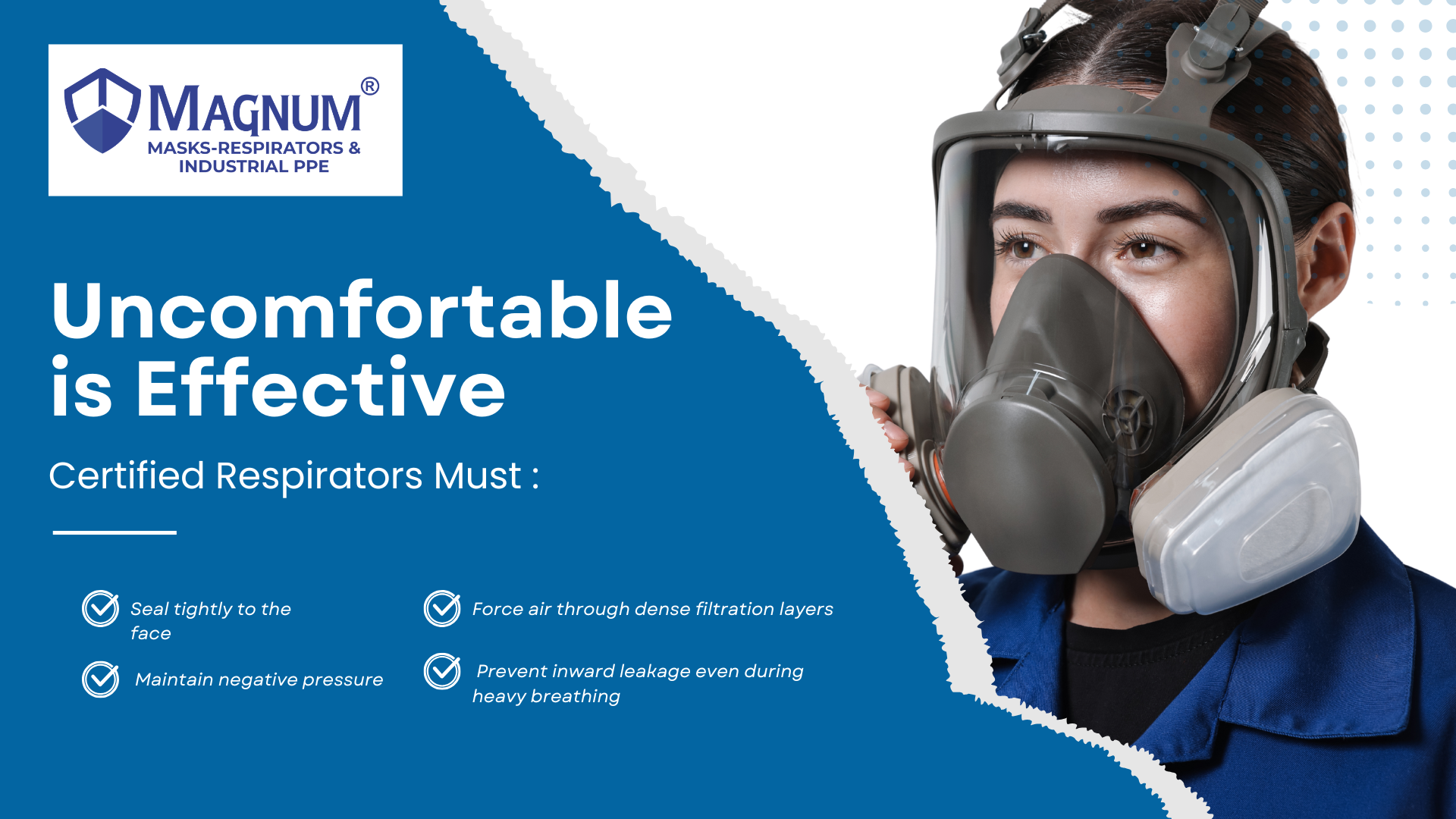
Respirators are now a daily necessity across construction sites, pharmaceutical plants, fabrication workshops, hospitals, and heavy manufacturing industries. Yet many workers across industrial regions still feel that wearing them for long hours can be tiring, warm, or restrictive. When this happens, respirators are loosened, pulled down, or worn inconsistently — and that is when a critical safety product silently stops protecting.
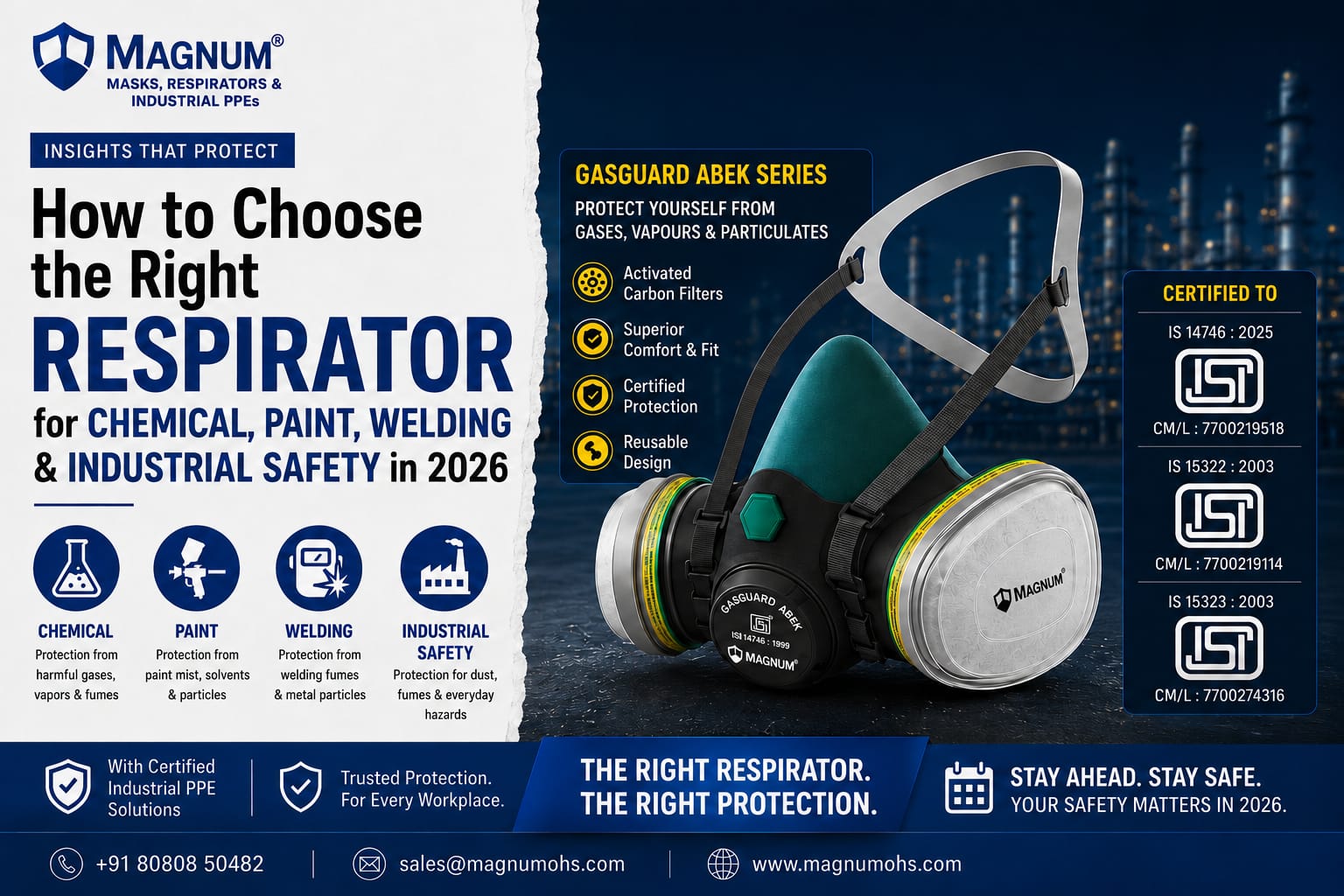
Importantly, discomfort is not always caused by poor design. In most real-world cases, the issue stems from incorrect model selection, improper fit, or lack of user training. When a respirator is sourced from a certified manufacturer producing BIS-approved IS 9473 filtering half masks or NIOSH-approved respirators, it is engineered not only for filtration performance but also for sustained usability during extended work shifts — provided it is selected and worn correctly.
Standards like IS 9473 (India) and NIOSH 42 CFR 84 (USA) define respirator performance through rigorous laboratory testing that evaluates:
While these parameters are technical on paper, their meaning on the shop floor is simple:
A properly certified respirator must consistently
✔ Filter airborne hazards
✔ Stay securely positioned during physical work
✔ Allow comfortable breathing for long durations
When the correct model is chosen from an experienced, certified respirator manufacturer, these issues are significantly reduced.
Across multiple industrial audits, one consistent observation emerges:
Workers comply with PPE protocols only when equipment allows natural movement, breathing, and communication.
Industrial procurement practices in India have evolved significantly. Organisations are moving beyond price-driven purchasing and prioritising certified respiratory PPE that meets recognized standards such as:
IS 9473 BIS certification for filtering half masks in India
NIOSH approval for international compliance
EN standards where global supply chains require them
Working with a trusted certified PPE manufacturer helps companies:
Pass internal and external safety audits
Meet multinational client compliance requirements
Build workforce confidence
Strengthen occupational health programs
For exporters, globally recognised certifications like NIOSH also support acceptance in regulated markets including North America, the Middle East, and Africa.
Small Practical Steps That Dramatically Improve Performance
Even the most advanced respirator cannot perform properly if worn incorrectly. A few simple practices can significantly enhance both comfort and protection:
Perform a face-fit check before entering hazard zones
Adjust straps evenly for balanced pressure distribution
Replace disposable respirators as recommended in dusty environments
Store respirators in clean, dry conditions between uses
Select respirators according to hazard type — not general purpose use
These simple steps require minimal effort but greatly improve real-world protection.
From Basic Compliance to Performance-Driven Safety
Industrial safety in India is steadily moving from checkbox compliance toward performance-based selection. Today, forward-thinking organisations evaluate respirators not only for certification marks but also for consistency, quality control, and worker acceptance.
Partnering with an established manufacturer producing BIS-certified IS 9473 respirators and NIOSH-approved models ensures dependable performance across batches — a factor that becomes especially important in large-scale industrial deployments and export-oriented operations.
Respirators are no longer occasional safety accessories — they are essential daily protection equipment. Because they are worn for extended periods, they must deliver both reliable filtration performance and practical comfort.
When the correct certified model is selected, properly fitted, and sourced from a trusted manufacturer, respirators integrate seamlessly into routine work. Workers no longer feel the need to adjust or remove them frequently — and protection continues quietly in the background, safeguarding health shift after shift.